
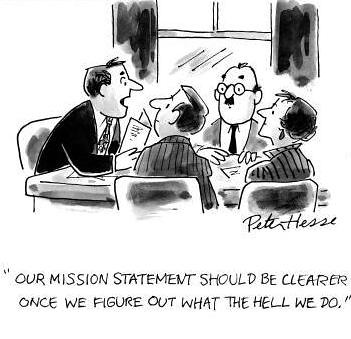
 I’ve paid attention to the mission, vision and values statements posted on the walls of several corporate offices I’ve visited recently. Nearly all of them use a lot of big, aspirational words that are combined to create long-winded phrases that are boring and generic — and too often cliched. With all due respect to the success of the Fortune 500, its listing of mission and values statements quickly becomes obscure after the first dozen or so.
I won’t implicate any specific companies, but I’ll cite some of the most commonly abused words: powered, innovation, integrity, honesty, trust, accountability, responsibility, solutions, excellence, superior, committed and standard. You get the idea. You’d think we’re getting ready for an intense session of bullshitbingo.
The problem with so many mission and values statements is that they’re more like superficial marketing slogans, something which humans are increasingly programmed to disregard, ignore or distrust. That contrasts with true values, which are long-term attributes that people internalize and act on through good times and bad.
Steven Blank, a retired entrepreneur and author of “The Four Steps To The Epiphany,” said in a recent speech (18:33 in the video): “Ethics and values are not what you put in plaques or tell your employees… It’s the stuff you practice when the stuff hits the fan.”
And that’s a fact.
While articulating mission statements and values is key, the true expression of them is when a company’s members — leaders from all ranks — actually live them out (or not). That’s why actions, narratives and artifacts that reflect and validate mission and values should be consciously curated, communicated, celebrated and preserved. They are far more credible and persuasive than the actual words — especially the favored, hollow words — relied upon as the foundation for most mission and values statements.
This also was my latest MediaPost column.
(Photo credit:Â Eduard Zelinger)
I just started a new company with a partner and we had to articulate our mission and vision statements. I think we stopped and started over several times because of the buzzword and bs meter. I really like this post, thanks Max.
Excellent point, Nick. Mission statestatements are especially distracting in
startup, when you’re not even yet sure what the business is. What is your
startup?
Great points, thanks for calling it what it is. We just had our non-profit’s annual retreat, and had our employees share what our core values (mission & vision) were and where we were succeeding/failing in accomplishing them. It was critical to have them articulate it, measure our success in doing it, and brainstorm about how to do it better.
You are completely right in what you are saying, but still, people (clients) fall for all the corporate “talk”…
We’ve stayed away from creating an official mission statement but allowed our culture over time to develop the “Things We Believe In”. We have listed (5) things:
-Perseverance
-Build things we are proud of
-Respect
-Ownership mentality for all
-CANI (Constant and Never ending Improvement)
And we train everyone for (2) hours the first day they are hired about what they mean to us and how we crafted them. Then we explain the order of importance (Our team, customer and profit). We discuss how we want them to have autonomy in their role and to make decisions based on these beliefs.
Then it is our job as a management team to review with the team on a regular basis how they are representing our core values.
While I was walking into the office today I was reminded we are not what we do in front of others, what makes us who we are is what we do when we think nobody is looking. I think this is true of individuals and corporations.
I like “we train everyone for (2) hours the first day they are hired about what they mean to us and how we crafted them.” I do the same with new hires on the first day.
I think the act of having members articulate what they think they are are more important than what is sever codified and posted to a wall.
our mission is to beat you with a shovel and then bury you 6 ft under w bs