
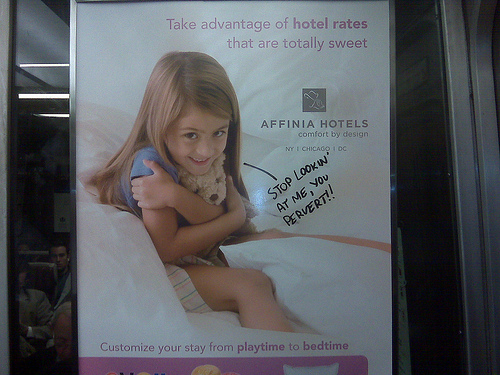
The target victim of thousands of advertising impressions per day, my brain has adapted by subconsciously filtering out 99 percent of them. It’s a survival mechanism.
Which ads penetrate me? As far as I can tell: Ones that I ask for. Ones that offer a solution when I have a specific problem. Ones that entertain me. Generally, ads that deliver something of value when I’m receptive or in need.
But I’ve noticed myself paying more attention to ads that have been iterated on by their audiences — ads I otherwise would’ve ignored. Advertisers and publishers categorize unintended audience iteration as vandalism. But there is one fact which can’t be disputed: these iterated ads simply garner more attention.
But why is that? They introduce a third dimension to the communications equation. Where there was once a one-way advertiser message and audience, there’s now advertiser message, iterator and then final audience. It’s a disintermediation to some degree. Often, there is more than one iterator that contributes. They mutate ads into something new, more human, less corporate. Those ads become unique and raw. They adopt a new cultural layer. They often filter, translate and clarify agenda. They surface irony and introduce humor. They even call bullshit. More than anything, the result becomes reflective and authentic. For me, that’s an improvement.
As my example above shows, taken on a recent Metro-North commuter train ride into New York City, ad iteration by audiences frequently happens in the analog world. It has for a long time.
Ironically, despite extreme interactivity, it doesn’t happen so much in the digital world. But I wish it would.
![Reblog this post [with Zemanta]](http://img.zemanta.com/reblog_c.png?x-id=7bc3fe67-59c6-4f5d-89c8-74dc65d65a8b)
I'm actually waiting for the first outdoor ad like this to ask to be vandalized, with a marker and eraser included. Here's a very popular one I snapped a photo of, writing back to the advertiser: http://www.flickr.com/photos/sherrett/2521518745/
That's a great one you found.
This is great! There are so many great examples of this throughout the public transportation system of metro New York. There've been many times a “commented” ad on the train was the high point of my day.
Wouldn't it be fun to have an international contest for the best subversive vandalized ad?
BR,
Lydia
Lydia Sugarman, CEO
Private Label Interactive
San Francisco – New York
Ph: 415.324.5825 – 212.260.0065
Get closer to your customers. Get in.Venntive.
Email + CRM = Simple Single Solution
A contest would be cool. Should it be sanctioned by advertisers or not?
Rep. Joe Wilson screamed “YOU LIE” at Pres. Obama during his speech to the joint session of Congress. Is that an example of what you're talking about?
Some similarities. It was a spontaneous, cultural overlay — a
disintermediation of a one-way communication. Poor taste, to be sure.
But isn't most political discourse, especially its advertising?
Rep. Joe Wilson screamed “YOU LIE” at Pres. Obama during his speech to the joint session of Congress. Is that an example of what you're talking about?
Some similarities. It was a spontaneous, cultural overlay — a
disintermediation of a one-way communication. Poor taste, to be sure.
But isn't most political discourse, especially its advertising?